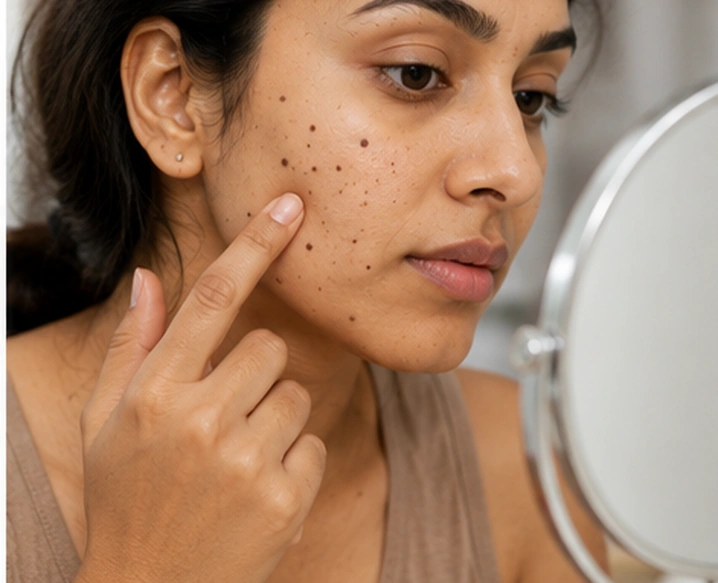
Look closely at your mother's cheeks, or your nani's, and you might spot them: tiny dark bumps sprinkled around the eyes and upper cheeks. Now a few are turning up on your face too. These are very likely DPN, short for dermatosis papulosa nigra. They're completely harmless, but they tend to multiply with age, and concealer rarely does much for raised spots. At Dadu Medical Centre, a skin clinic in Delhi, DPN treatment focuses on removing these bumps safely while protecting your natural skin tone, which matters a lot on Indian skin. Dr. Nivedita Dadu and her team pick the method that suits your spots, not the other way round.
Dermatosis papulosa nigra, usually just called DPN, is a common skin condition where small dark spots and bumps form, mostly on the face. They like the area around the eyes and cheekbones, and the neck. Some people get them on the chest or upper back as well.
DPN isn't contagious and it isn't cancer. Most people don't feel anything, though a few notice occasional itching or irritation when the bumps catch on clothes or jewellery. The spots usually start in the teens or twenties and don't go away by themselves. Over the years they tend to get bigger and more numerous, so someone with a handful in their twenties may have many more by their forties. That's why plenty of people choose to deal with them earlier rather than later.
The exact cause isn't known yet, but a few things clearly raise the odds.
DPN is sometimes mixed up with moles, warts or seborrheic keratosis. They can look alike, but each is treated differently, so a proper check always comes first.
You can't stop DPN completely, especially if it runs in the family. These habits help keep things in check and protect your skin.
Wear sunscreen every day. It won't stop DPN, but it protects the skin around the spots and helps prevent dark marks after removal.
Don't pick or scratch the bumps. That can lead to bleeding, infection and dark scars.
Never cut or tie them off at home. Thread, blades or nail clippers can easily leave a permanent mark on your face.
Keep away from wart removers and strong acids. They can burn the skin and leave patches darker than the spots themselves.
Treat them while they're few and small. Fewer spots mean quicker sessions and faster healing.
Get any changing spot checked. If a bump grows fast, bleeds or looks different from the others, show it to a dermatologist.
Pick a dermatologist over a parlour. Removing DPN on Indian skin needs the right technique to avoid scars and pigmentation.
Book a free consultation and find out the safest way to remove those dark spots for your skin type.
Get in touch
Removing DPN looks simple, but on Indian skin it takes a careful hand. Go too deep and you're left with a small scar. Go too harsh and you get a dark patch that lasts longer than the spot ever did. At Dadu Medical Centre, our doctors first confirm the bumps really are DPN, and not moles, warts or something else that needs a different approach. Dr. Nivedita Dadu and her team then choose the method and settings to suit your skin, and walk you through aftercare so healing goes smoothly. Since new spots often keep appearing over the years, you'll also know what to expect later on and when a touch-up makes sense.
Neither. It's a harmless skin growth. Some people find it a little itchy now and then, but it doesn't cause any health problems.
Nobody knows for sure. It mostly runs in families, it's more common in darker skin and in women, and the spots tend to increase with age.
The bumps are usually removed with CO2 laser or radiofrequency. Which one depends on the size and number of spots, and on your skin type.
Not much. A numbing cream goes on first, so most people only feel mild pricking or warmth.
Yes, when it's done by a dermatologist with the right settings. The main risk on darker skin is temporary pigmentation, and careful technique plus good aftercare help avoid it.
Very little. Small crusts form where the spots were and fall off by themselves in about a week. Most people go back to work the same day.
Some darkness may stay for a few weeks, but it usually fades. Sunscreen and leaving the crusts alone make a big difference.
The removed ones usually don't. New spots can keep forming over time, though, so touch-up sessions every few years are common.
Best to wait until the crusts have fallen off. After that, go back to your usual makeup, with sunscreen underneath.
Most adults can. The spots usually show up from the late teens onwards, and removal can be done whenever they start to bother you.
Book a free consultation and find out the safest way to remove those dark spots for your skin type.

A-2/6, Vasant Vihar, New Delhi - 110057
+91 98109 77786 / +91 96677 21501

J-12/28, 1st Floor, Near Rajouri Garden Metro Station, New Delhi - 110027
+91 98109 77786 / +91 96677 21501
Recognised for excellence in dermatology and skin care.
Safe clinical protocols and technology-led treatment planning.
Personalised care delivered by experienced dermatology professionals.