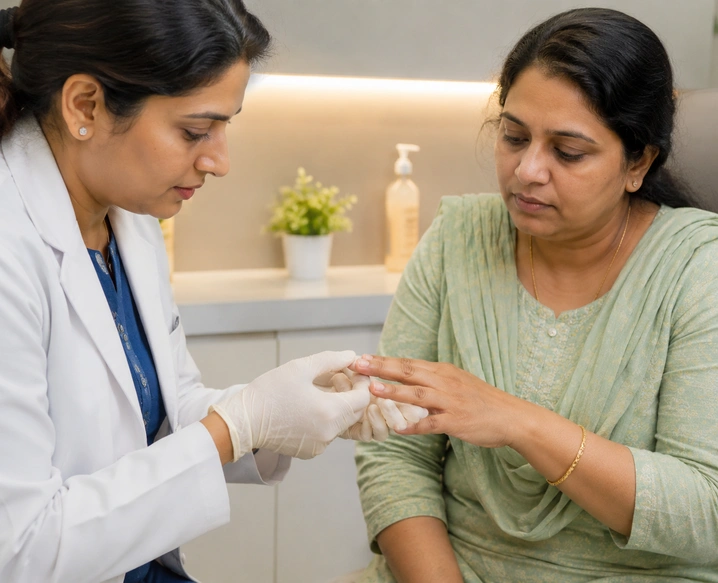
Your big toe throbs every time you squeeze into office shoes, so you've been living in open chappals for weeks. Or maybe a nail got crushed, or it's turned thick, yellow and crumbly and nothing from the chemist has helped. Sometimes the kindest fix is to remove the problem nail, fully or partly, and let a healthy one grow back in its place. At Dadu Medical Centre, a skin clinic in Delhi, nail avulsion treatment is a short procedure done after the area is properly numbed. Dr. Nivedita Dadu and her team first check whether removal is really needed, and only then plan it.
Nail avulsion is a minor procedure in which a damaged nail, or just the troublesome part of it, is removed from the nail bed. It's most often done on toenails, especially the big toe, but fingernails can need it too.
The area is numbed first, so the procedure itself isn't painful. It can be partial, where only the ingrown edge comes off, or total, where the whole nail plate is lifted away. In both cases, a new nail slowly grows back. Left alone, these nail problems tend to keep flaring up, and an ingrown toenail in particular can get infected again and again.
Most nail problems that end up needing removal start small and get worse over weeks. The usual culprits are:
A few simple habits keep most of these problems away.
Cut toenails straight across. Leave the corners alone, and don't cut them too short.
Pick shoes with room for your toes. Your toes shouldn't feel squeezed, especially at the end of a long day.
Keep your feet dry. Change socks when they get sweaty, and let your feet breathe when you can.
Wear slippers in shared showers and pool areas. That's where fungal infections usually spread.
Protect your feet at work or the gym. Sturdy, closed shoes help if heavy things could drop on them.
Don't dig out an ingrown nail yourself. Home surgery with a blade or nail cutter often makes the infection much worse.
Check your feet regularly if you have diabetes. Catching a problem early makes a big difference.
See a dermatologist early. If a nail stays painful, swollen or keeps getting infected, get it treated properly rather than living with it.
Book a free consultation and find out whether your nail problem needs removal or can be treated another way.
Get in touch
Most people put off getting a painful nail checked, mostly because they're nervous about the procedure. Honestly, it's usually much simpler than they imagine. At Dadu Medical Centre, our doctors first look at whether the nail really needs to come off, or whether medicine and better nail care could sort it out on their own. If removal is the right call, Dr. Nivedita Dadu and her team numb the area properly, take off only as much as is needed, and dress it carefully. You'll go home knowing how to look after it, what's normal while it heals and what isn't. And you'll come back for a follow-up, so someone checks that it's healing the way it should.
The usual reasons are a painful ingrown nail, a nail damaged by injury, or a fungal infection that hasn't cleared with medicine. Removing the problem nail lets the area heal properly.
The toe or finger is numbed first with a small injection. Then either the ingrown edge or the whole nail is gently lifted off, and the area is cleaned and dressed.
The numbing injection stings for a few seconds, and after that you shouldn't feel pain during the procedure. Some soreness afterwards is normal and settles with simple painkillers.
In most cases, yes. A fingernail takes a few months to grow back fully, while a toenail can take closer to a year. If a matricectomy is done, that treated edge won't regrow.
Most people are back to their normal routine within a day or two. Wear open or loose footwear for a week or so while it heals.
It can, especially if nails are cut too short or shoes are tight. For nails that keep returning, treating the root of that edge stops it from growing back.
It can be done, but with extra care. Tell your doctor about diabetes or circulation problems beforehand, since healing needs closer watching.
Keep the dressing clean and dry, change it as advised, and avoid swimming or tight shoes for a while. Come back if you notice more redness, pus or swelling.
Not on the treated nail until it has fully healed. After that, nail polish is fine, though it helps to give the new nail some breathing time.
Yes. Ingrown toenails are quite common in teenagers, and the procedure is safe for them with the right care.
Book a free consultation and find out whether your nail problem needs removal or can be treated another way.

A-2/6, Vasant Vihar, New Delhi - 110057
+91 98109 77786 / +91 96677 21501

J-12/28, 1st Floor, Near Rajouri Garden Metro Station, New Delhi - 110027
+91 98109 77786 / +91 96677 21501
Recognised for excellence in dermatology and skin care.
Safe clinical protocols and technology-led treatment planning.
Personalised care delivered by experienced dermatology professionals.