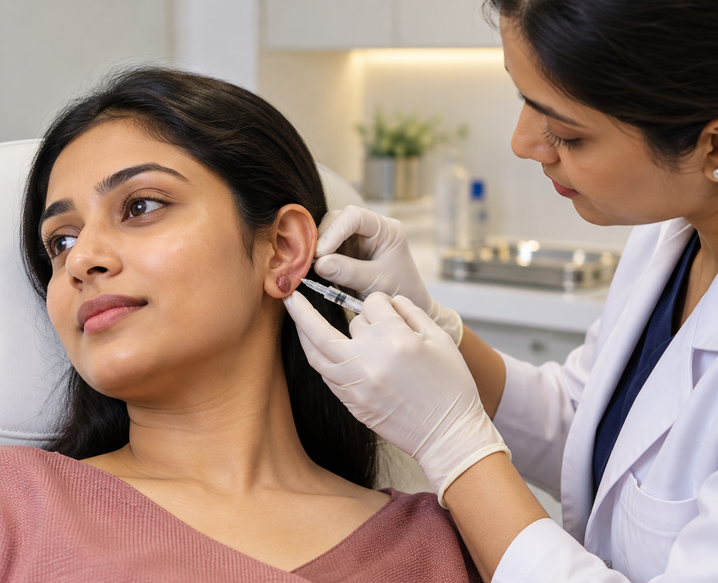
It was meant to be a tiny ear piercing. Or a pimple on your chest that healed months ago. Except the scar didn't stop at healing. It kept growing, thick, shiny and a little pink, spreading past the edges of the original wound. Some days it itches. Some days it's tender when your shirt rubs against it. That's a keloid. It isn't dangerous, but it can be uncomfortable, and plenty of people hate how it looks. At Dadu Medical Centre, a skin clinic in Delhi with centres in Vasant Vihar and Rajouri Garden, keloid treatment focuses on flattening the scar, easing the itch and lowering the chance of it growing back. Dr. Nivedita Dadu and her team plan it around where the keloid sits and how long you've had it.
When skin heals, it lays down collagen to close the wound. Normally it knows when to stop. With a keloid, it doesn't. The healing tissue keeps building, so the scar rises above the skin and spreads beyond where the injury actually was.
They turn up most on the chest, shoulders, upper back, arms, neck and earlobes. A keloid isn't the same as a hypertrophic scar. That one is also raised, but it stays inside the wound's edges and often flattens with time. Keloids rarely shrink by themselves. They're not harmful and not contagious, but they can come back after treatment, which is why how you treat them matters as much as what you use.
If you're prone to them, almost any break in the skin can start one. The usual starting points:
Then there's family. If a parent or sibling gets keloids, your chances go up. They're also more common in darker skin, and usually start somewhere between the teens and the thirties.
If you know you're prone, a few precautions go a long way.
Think twice about piercings and tattoos. Even a small one can set off a keloid.
Treat acne early, before deep pimples get a chance to scar.
Don't pick at healing wounds or scratch bites.
Tell your surgeon you form keloids before any planned operation.
Keep healing wounds clean and covered.
Put sunscreen on new scars so they don't turn darker.
Get a growing scar checked early. Small, new keloids respond much better than big, old ones.
Never try to cut one off yourself. It almost always grows back bigger.
medicine injected straight into the keloid, usually every few weeks. It softens and flattens the scar and takes the itch down. For most keloids, this is the main treatment.
helps tone down redness and improves how the scar looks and feels, often used alongside injections.
soften the scar and calm the itch. Useful for smaller, newer keloids, or to support the other treatments.
Book a free consultation at our clinic in Delhi and find out how that raised scar can be treated.
Get in touch
Keloids are tricky. Treat one too aggressively, or cut it out without a proper plan, and it often comes back bigger than before. At Dadu Medical Centre, our doctors first make sure it really is a keloid, and not a hypertrophic scar or some other kind of growth. Dr. Nivedita Dadu and her team then pick a treatment that suits its size and spot, whether that's an earlobe, the chest or a shoulder, and adjust it as the scar responds. You'll get an honest picture, too. Keloids can be flattened and made a lot more comfortable, but it takes patience and a few follow-ups. You can be seen at either our Vasant Vihar or Rajouri Garden centre.
Ans. A thick, raised scar that grows past the edges of the original wound. It's made of extra collagen the skin keeps laying down after healing.
Ans. Any skin injury in someone who's prone, like acne, piercings, vaccinations, surgery, burns or bites. Family history plays a big part.
Ans. Usually with steroid injections straight into the keloid, sometimes along with laser therapy and prescription creams.
Ans. It can be flattened and softened a lot. Getting rid of it completely is harder, and cutting it out on its own often makes it come back.
Ans. Injections are usually given every few weeks, and most keloids need several rounds.
Ans. The injections sting a little. Numbing can make it easier.
Ans. It can, especially without follow-up. Regular checks help catch any regrowth early.
Ans. Yes. Earlobe keloids are some of the most common, and they usually respond well.
Ans. Both are raised. A hypertrophic scar stays inside the wound and often fades with time. A keloid spreads beyond it and rarely flattens without treatment.
Ans. If you form keloids easily, it's safer to avoid them, or at least talk to your doctor first.
Book a free consultation at our clinic in Delhi and find out how that raised scar can be treated.
A-2/6, Vasant Vihar, New Delhi - 110057
+91 98109 77786 / +91 96677 21501
J-12/28, 1st Floor, Near Rajouri Garden Metro Station, New Delhi - 110027
+91 98109 77786 / +91 96677 21501
Recognised for excellence in dermatology and skin care.
Safe clinical protocols and technology-led treatment planning.
Personalised care delivered by experienced dermatology professionals.