


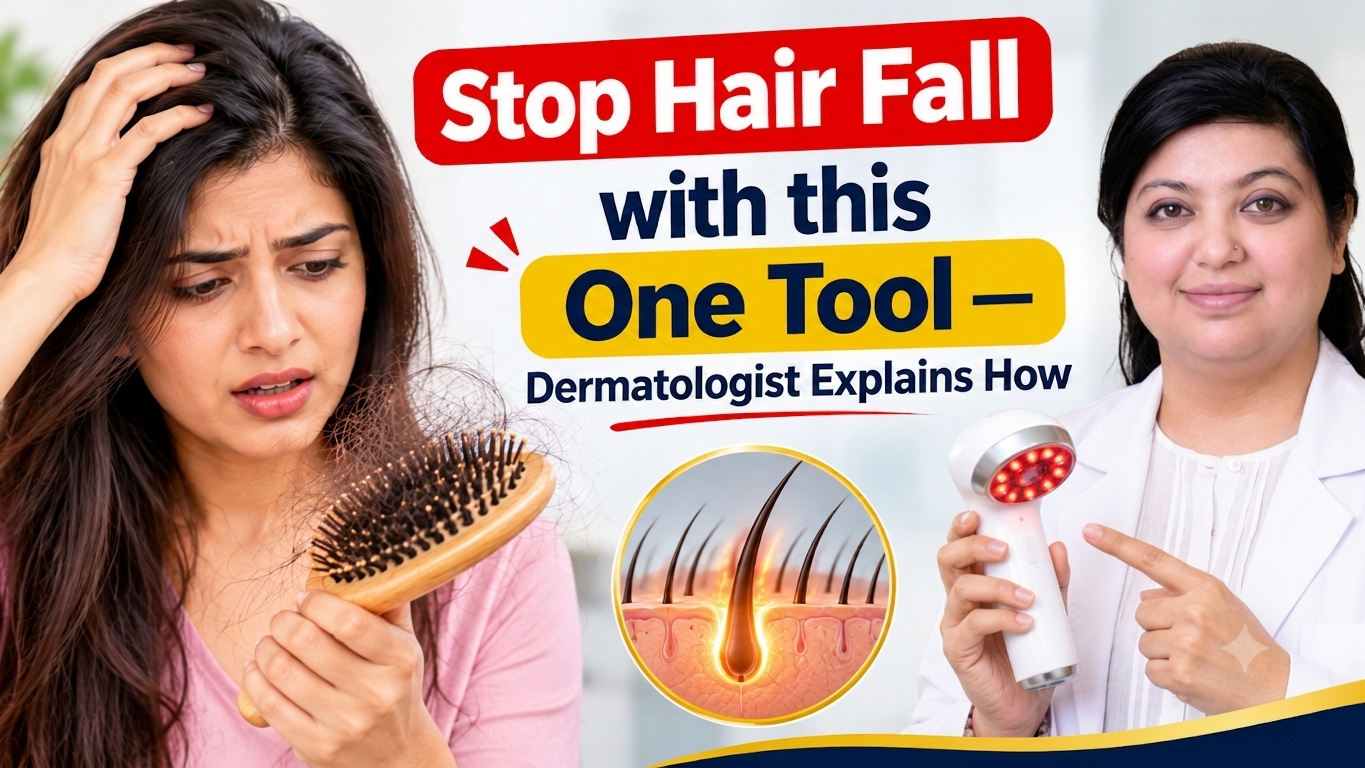
Derma Roller for Hair Fall: The Right Way to Use It, According to a Dermatologist
If you've been dealing with hair fall and keep hearing people recommend derma rollers, you're probably also wondering whether it's actually worth the hype or just another trend. This is genuinely one of the most common questions that comes up when people search for treatment in Delhi for hair thinning, and there's a good reason for that. Used correctly, a derma roller can make a real difference. Used incorrectly, it can end up doing more harm than good.
So let's actually break down what a derma roller is, how it works, and just as importantly who should stay away from it entirely.
What Exactly Is a Derma Roller?
A derma roller is a small, handheld device with a cylindrical drum covered in extremely fine needles. When you roll this device across your scalp, it creates tiny micro-channels in the skin. These micro-channels do two important things: they improve blood supply to the scalp, and they allow any serum you apply afterward to penetrate far more effectively than it would on its own.
Multiple studies have actually compared using a serum alongside a derma roller versus using that same serum alone, and the difference is significant. Hair growth results are noticeably better when the serum is paired with derma rolling, compared to applying the serum by itself without any rolling.
How Does It Actually Improve Hair Growth?
There are four scientifically backed ways a derma roller helps with hair growth, and understanding these makes it much easier to see why this isn't just another skincare gimmick.
First, the micro-channels created by rolling allow serums to penetrate deeper into the scalp instead of just sitting on the surface. Second, rolling increases blood supply by releasing vascular endothelial growth factor, which means more nutrients reach the hair follicles directly. Third, it activates bulge stem cells in the scalp, which in turn activates hair follicles and encourages new hair growth. And fourth this one's particularly interesting derma rolling helps push hair follicles back into the anagen phase, which is the active growth phase. This matters a lot in hormonal hair thinning, where follicles tend to get stuck in the resting phase instead.
Choosing the Right Needle Depth
Derma rollers come in needle depths ranging from 0.25mm all the way up to 2mm. For home use, you should stick to 0.25mm to 0.5mm anything deeper than that isn't recommended for at-home use at all. In clinics, of course, higher-strength devices are used under supervision, but that's a very different setting from doing this yourself at home.
The Correct Technique
If you're using a 0.25mm or 0.5mm device, you don't need a numbing cream beforehand, since these depths are mild enough not to require one. When rolling, the best technique is to roll the device along the X-axis, Y-axis, and Z-axis, about five to eight times each, moving it gently across your scalp. One important note for anyone with longer hair is to always keep the rolling motion unidirectional rather than going back and forth, since hair can get caught and tangled in the device otherwise, increasing the risk of breakage.
|
Needle Depth |
Suitable For |
|
0.25mm – 0.5mm |
Home use, no numbing cream needed |
|
1mm – 1.5mm |
Clinic use only, under supervision |
|
Above 1.5mm |
Not recommended outside professional clinical settings |
How Often Should You Use It?
Three times a week is the ideal frequency for derma rolling. As for when to apply serum afterward if you're using minoxidil, wait at least 12 hours after rolling before applying it. If you're using a non-minoxidil hair serum, meaning something with ingredients like Redensyl, Procapil, or Capixyl, you can apply it immediately, since these tend to cause much less irritation.
Since you're using the device three times a week, the needles will go blunt fairly quickly, so it's a good idea to replace your derma roller once a month, or once every four to six weeks if you're using it that frequently.
Cleaning Your Derma Roller Properly
Cleaning matters more than people realise here, since a dirty derma roller can introduce infection risk. Clean it using Betadine, mix one teaspoon of Betadine in a glass of water and soak the roller for about five minutes. After that, rinse it under running water, air dry it, and then store it. Alternatively, cleaning it with alcohol also works well.
Who Should NOT Use a Derma Roller
This part is genuinely important, and it's worth reading carefully before you start. Derma rolling should be avoided if you have active psoriasis, seborrheic dermatitis, or dandruff. It's also not recommended if you have a tendency toward keloid formation, scalp folliculitis, any kind of active infection, or bleeding disorders. If you're dealing with cicatricial or scarring alopecia, derma rolling simply won't help, since the follicles themselves are already damaged beyond this kind of stimulation. There isn't sufficient research on derma rolling during pregnancy either, so it's best avoided during that time. And for alopecia areata, since it's an autoimmune condition, there isn't clear evidence on how much benefit derma rolling actually provides.
|
Condition |
Should You Use a Derma Roller? |
|
Male/female pattern hair thinning |
Yes, well-suited for this |
|
Telogen effluvium (regrowth phase only) |
Yes, once shedding has stopped |
|
Active psoriasis, dandruff, infection |
No |
|
Scarring alopecia |
No, won't help |
|
Pregnancy |
Avoid, insufficient research |
Where It Genuinely Works Well
Derma rolling shows the best results in male and female pattern hair loss, meaning hormonal hair thinning. It also helps with telogen effluvium, the kind of hair fall where hair suddenly starts shedding in clumps, often after delivery, illness like COVID, dengue, or typhoid, or after crash dieting. That said, timing matters a lot here. If your hair is still actively shedding, avoid derma rolling during that phase, since the micro-trauma it creates can actually worsen the shedding. Once the shedding has stopped and your hair has moved into the regrowth phase, that's when derma rolling becomes genuinely useful.
A Few Things to Keep in Mind
Always use mild pressure. This isn't something that needs to hurt to work. If you're using a 0.25mm or 0.5mm device, don't expect visible bleeding points, since clinic-grade 1mm to 1.5mm devices are what typically produce that kind of redness. Mild erythema is completely fine, but you don't need to wait for redness or bleeding to know it's working. That's simply not how it functions at these home-use depths.
Mild scalp sensitivity after rolling is normal. However, if you notice significant swelling, burning, irritation, or signs of infection, something has gone wrong, and it's important to consult an experienced, qualified dermatologist rather than continuing on your own.
Setting Realistic Expectations
Hair growth takes time genuinely around three months minimum before you'll see any noticeable change, and often three to six months for a more meaningful result. Combining derma rolling with minoxidil tends to give better results than either alone, and adding finasteride into that combination improves results even further. If you're doing derma rolling with minoxidil and finasteride at home while also getting in-clinic treatments, the results tend to be the most significant of all.
This is a conversation that comes up regularly during consultations at Dadu Medical Centre. Dr. Nivedita Dadu often points out that hormonal hair thinning is a condition where consistent effort genuinely translates into better results the more structured your approach, the more rewarding the outcome tends to be over time. If you're dealing with persistent hair fall and want a proper assessment of what's actually causing it, consulting a dermatologist in Delhi can help you figure out whether derma rolling alone is enough or whether it needs to be combined with other treatments.
For those looking into a reliable hair clinic in Delhi that can guide you through building the right combination of at-home care and clinical support, a proper consultation makes a significant difference compared to figuring this out through trial and error. A good clinic in Delhi will evaluate your hair fall pattern, scalp condition, and overall health before recommending a treatment plan suited specifically to you.
Final Thoughts
A derma roller can be a genuinely effective, low-cost addition to your hair fall routine but only when used correctly, at the right depth, frequency, and in combination with the right serums. It's not a quick fix, and results take patience. If you follow the technique carefully and still don't see improvement after a few months, or if you're unsure whether it's right for your specific type of hair fall, reaching out to experienced doctors in Delhi is always a smarter move than continuing to guess.
|
How Derma Rolling Helps |
Effect on Scalp/Hair |
|
Creates micro-channels |
Improves serum penetration |
|
Increases blood supply |
Delivers more nutrients to follicles |
|
Activates stem cells |
Stimulates follicle activity |
|
Pushes follicles into anagen phase |
Encourages active hair growth |
Frequently Asked Questions (7)
Q1. How often should I use a derma roller for hair fall?
Ans:- Three times a week is the recommended frequency for home use. Consistency matters more than increasing frequency beyond this.
Comments (0)
Loading comments...