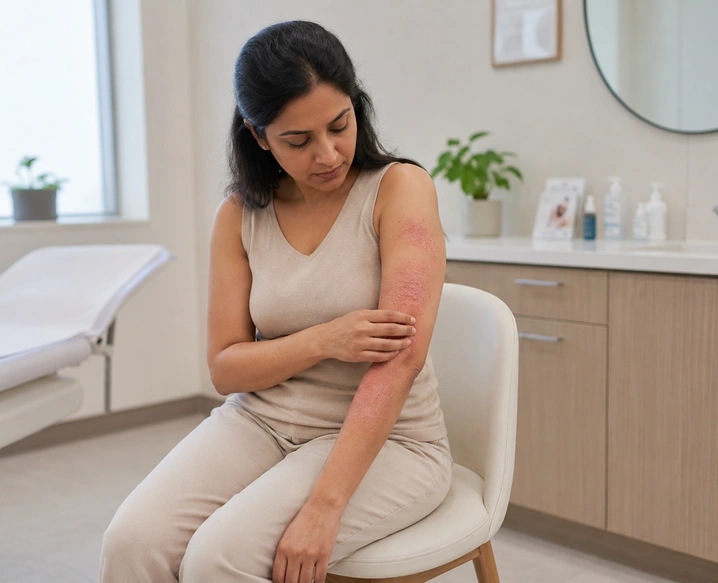
Your child has had dry, itchy patches since they were a baby. The creases behind their knees get red and rough, and bedtime turns into a battle with scratching. Maybe you had the same thing growing up, or someone in the family has asthma or hay fever. That pattern has a name: atopic dermatitis, the most common form of eczema. It usually starts in early childhood, and for some people it carries on into adult life. At Dadu Medical Centre, a skin clinic in Delhi, atopic dermatitis treatment focuses on repairing the skin barrier, calming the itch and keeping flares further apart. Dr. Nivedita Dadu and her team also help families understand what's going on, so home care becomes easier.
Atopic dermatitis is a long-term skin condition that makes the skin dry, itchy, red and easily irritated. The word "atopic" points to a tendency to react strongly to things that are harmless for most people, like dust, pollen or certain foods. People with this tendency often have higher levels of an allergy antibody called IgE, and many of them, or their family members, also have asthma or allergic rhinitis.
A big part of the problem sits in the skin barrier. Many people with atopic dermatitis don't make enough of a protein called filaggrin, which helps hold the top layer of skin together. Without it, moisture escapes easily, and irritants, bacteria and viruses get in more easily. That's why the skin feels dry and why it gets infected more often.
It usually shows up before the age of five. Many children improve as they grow, but some carry it into their teens and adulthood, with flares that come and go.
Atopic dermatitis comes from a mix of genes, a weak skin barrier and an immune system that overreacts. Everyday triggers then set off flares.
You can't change your genes, but the right daily habits make a real difference to how often flares happen.
Moisturize at least twice a day. A thick, fragrance-free cream straight after bathing is the single most useful habit.
Keep baths short and lukewarm. Hot water feels good for a moment but dries the skin fast.
Use a mild, soap-free cleanser.
Dress in soft cotton. Avoid wool and scratchy fabrics directly against the skin.
Keep nails short, especially for children, to limit damage from night-time scratching.
Reduce dust at home. Wash bedding often and keep soft toys to a minimum in the bedroom.
Don't cut out foods without testing. Unnecessary diets can harm a child's nutrition without helping the skin.
Start treatment early in a flare. It settles faster when it's treated before the skin gets thick and broken.
Book a free consultation at our clinic in Delhi and get a clear, practical plan for managing atopic dermatitis at home.
Get in touch
With atopic dermatitis, a lot of the work happens at home, at bath time and bedtime, which is why clear guidance matters as much as the prescription. At Dadu Medical Centre, our doctors take time to understand the pattern: when flares start, what seems to set them off, and whether allergies or asthma run in the family. For children, parents get a simple, practical routine they can follow without guesswork. Dr. Nivedita Dadu and her team treat the flare you have now, then help you stretch out the calm periods in between. Plans are adjusted as a child grows or as seasons change, so you're never stuck with a routine that has stopped working.
It's the most common type of eczema. When people say "eczema", they often mean atopic dermatitis, especially in children.
A weak skin barrier, often linked to low filaggrin, combined with an immune system that overreacts. It tends to run in families with allergies or asthma.
Most plans combine prescription creams for flares, a daily moisturizing routine and help with itching. Stubborn cases may need phototherapy or other advanced options.
No. It can't spread from one person to another, even when the skin looks very inflamed.
Many children improve a lot as they get older. Some continue to have milder flares into their teens or adulthood.
Often, yes. Children with atopic dermatitis are more likely to develop asthma or allergic rhinitis later, though not all of them do.
Yes, when prescribed and used correctly. The right strength, amount and duration make them both safe and effective.
Not without proper testing. Food allergy plays a role in only a small number of children, and unnecessary restrictions can do more harm than good.
The weak barrier lets bacteria in more easily. Oozing, crusting or sudden worsening should be checked quickly.
Moisturize well before bed, keep nails short, dress in soft cotton and keep the room cool. Your doctor may also suggest medicine to ease the itch.
Book a free consultation at our clinic in Delhi and get a clear, practical plan for managing atopic dermatitis at home.
Dr. Nivedita Dadu explains what makes atopic skin so dry and reactive, how to build a routine that works, and when a flare needs a doctor's attention.
Atopic dermatitis (एक्जिमा) क्या है उसके लक्षण और इलाज

A-2/6, Vasant Vihar, New Delhi - 110057
+91 98109 77786 / +91 96677 21501

J-12/28, 1st Floor, Near Rajouri Garden Metro Station, New Delhi - 110027
+91 98109 77786 / +91 96677 21501
Recognised for excellence in dermatology and skin care.
Safe clinical protocols and technology-led treatment planning.
Personalised care delivered by experienced dermatology professionals.