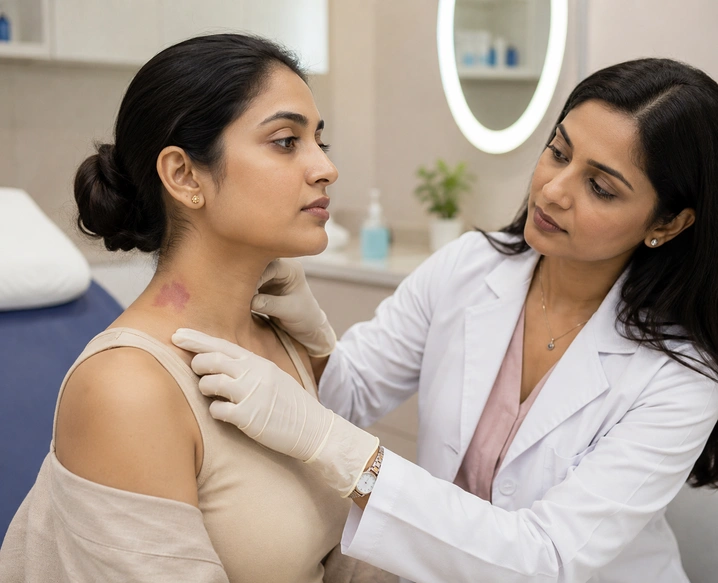
Maybe it's been on your cheek for as long as you can remember, and you're tired of people asking about it. Or maybe it's a new red patch on your baby's forehead, and you can't stop wondering whether it'll grow. Most birthmarks are completely harmless. Some fade on their own, while others stay put and can make people self-conscious. At Dadu Medical Centre, a skin clinic in Delhi, birthmark removal begins with working out exactly what kind of mark it is. Dr. Nivedita Dadu and her team then tell you honestly what can be done, whether that's lightening it, removing it, or simply keeping an eye on it.
Birthmarks are patches of discolored skin that are there at birth or show up in the first few weeks of life. They come in all shapes and sizes. Some are as small as a freckle, while others cover a large part of the face, arm or back. They can be flat or raised, and brown, black, bluish or red.
A few, like strawberry marks and bluish patches on the back, often fade as a child grows. Many others stay for life, and some, like port-wine stains, can even get darker or thicker with age. That's why knowing the type matters so much.
There's no single clear cause, and in most cases nobody did anything to bring it on. What doctors do know is this:
One thing worth clearing up: eating certain foods, cravings, stress or an eclipse during pregnancy do not cause birthmarks. It's a very common worry among mothers, but there's nothing to support it.
Birthmarks can't be prevented. A bit of care, though, keeps them from getting worse and helps treatment work better.
Use sunscreen on the mark. Sun tends to darken pigmented birthmarks and makes them harder to lighten later.
Don't bleach, scrub or burn it. Home remedies and harsh creams can scar the skin and leave the patch looking worse than before.
Protect raised marks. Keep them away from rough clothing, and anything that might scratch or cut them.
Keep an eye on birthmark moles. Note any change in size, shape or color, and get it checked.
Show a new red lump on your baby to a doctor early. Especially if it's near the eye, nose, lips or nappy area, where growth can cause problems.
Take a photo now and then. Slow changes are much easier to spot when you can compare pictures.
Start treatment early if you're advised to. Some marks, red ones in particular, tend to respond better when treated young.
See a dermatologist before trying anything. The right treatment depends entirely on the type of birthmark.
may help lighten flat brown birthmarks such as caf�-au-lait spots.
the same laser used for tattoo removal, which may suit some deeper pigmented marks.
Book a free consultation and find out what type of birthmark you're dealing with and what can be done about it.
Get in touch
Two birthmarks can look alike and still need completely different handling. A red patch on a baby might fade by itself within a few years, while a port-wine stain usually won't, and a caf�-au-lait spot responds very differently from a bluish patch near the eye. At Dadu Medical Centre, the first step is working out exactly what kind of mark you're dealing with. Our doctors will look at its color, depth and location, and ask how it has changed over time. Dr. Nivedita Dadu and her team then explain what's realistic, whether that's lightening, removal or just watching it. If it's your child's birthmark, you'll get a straight answer on whether it needs treatment now, later, or not at all.
Almost always, no. Most are only a cosmetic concern. A few, like large birthmark moles or red marks near the eye, need regular checks, which is why getting one looked at at least once is a good idea.
No. Food, cravings, stress or an eclipse during pregnancy don't cause birthmarks. In most cases the reason simply isn't known.
The type is identified first. Pigmented marks are usually treated with Q-switched laser, red marks with vascular laser, and raised moles may be removed.
Some can be lightened a great deal, and certain small raised ones can be removed fully. Others may only fade partly, so your dermatologist will tell you honestly what to expect for your mark.
Some do. Many strawberry marks shrink over the first few years, and bluish patches on the lower back usually fade in childhood. Port-wine stains and caf�-au-lait spots generally don't.
Yes, when it's done by a dermatologist with settings suited to young skin. For some red marks, starting earlier can actually give better results.
It varies a lot. Lighter marks may need only a few sessions, while deeper or larger ones can take several, spaced some weeks apart.
Very little. The area may look red, a little swollen or slightly darker for a few days. Keep it out of the sun and use sunscreen while it settles.
If it grows quickly, bleeds, changes color or shape, or if a red lump is near your baby's eye, nose or mouth. Don't wait on any of these.
Yes. Color-correcting and camouflage makeup can hide most marks quite well. Just skip makeup on the area for a day or two after a laser session.
Book a free consultation and find out what type of birthmark you're dealing with and what can be done about it.
A-2/6, Vasant Vihar, New Delhi - 110057
+91 98109 77786 / +91 96677 21501
J-12/28, 1st Floor, Near Rajouri Garden Metro Station, New Delhi - 110027
+91 98109 77786 / +91 96677 21501
Recognised for excellence in dermatology and skin care.
Safe clinical protocols and technology-led treatment planning.
Personalised care delivered by experienced dermatology professionals.