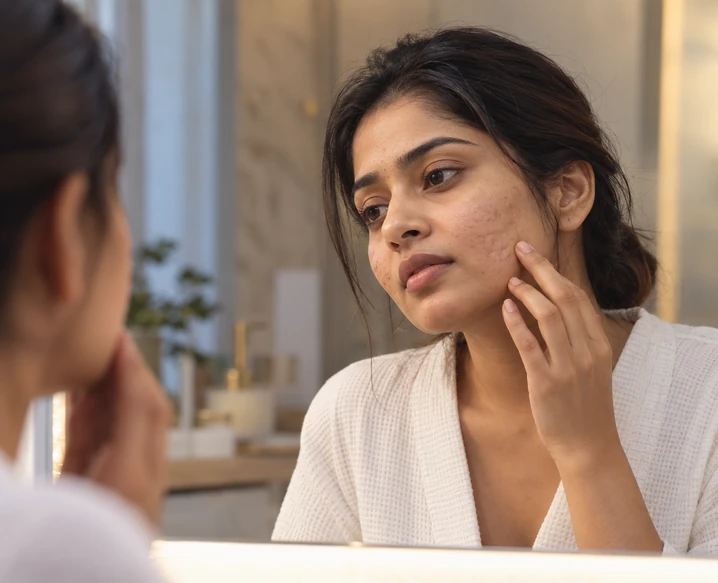
Most people with acne scars have tried a few things already. A serum, a peel or two, maybe a round of laser, and the pits on the cheeks still look the same under the bathroom light. With rolling and boxcar scars this happens a lot, and the reason is usually under the skin, not on it. Thin bands of scar tissue form while the acne heals and keep the scar stuck to the deeper layers, so it stays pulled down no matter what you apply on top. Subcision treatment in Delhi at Dadu Medical Centre is a small procedure, done without any cuts, where the skin doctor uses a fine needle to release those bands from below. Once they're freed the dent starts coming up, and the tiny injury left under the skin also gets new collagen going in that spot. It's mainly used for depressed acne scars but also helps with scars left after chickenpox, surgery or an injury, depressed skin grafts and some wrinkles. Available at Dadu Medical Centre Vasant Vihar (South Delhi) & Rajouri Garden (West Delhi), under Dr. Nivedita Dadu.
When a deep pimple heals, the skin repairs it in a hurry. Sometimes it doesn't make enough collagen to fill the spot back in, and at the same time it lays down fibrous strands connecting the base of the scar to the tissue underneath. These strands hold the scar down a bit like stitches, and dermatologists call this tethering.
Most surface treatments only reach the top layers of skin. Subcision goes after the bands, and that's why it often helps people whose scars haven't shifted much with other options.
Subcision gives the best results on rolling scars, the wide, wavy pits with sloping edges that make skin look uneven in side lighting. These are usually the most tethered, so they lift well once released. Boxcar scars, which are rounder with sharper edges, also respond, often along with another treatment. It is also used for:
It isn't the right choice for keloid or hypertrophic (raised) scars, because the issue there is extra tissue rather than tethering. Narrow, deep ice-pick scars also don't do well with subcision alone and are normally treated with methods like TCA CROSS.
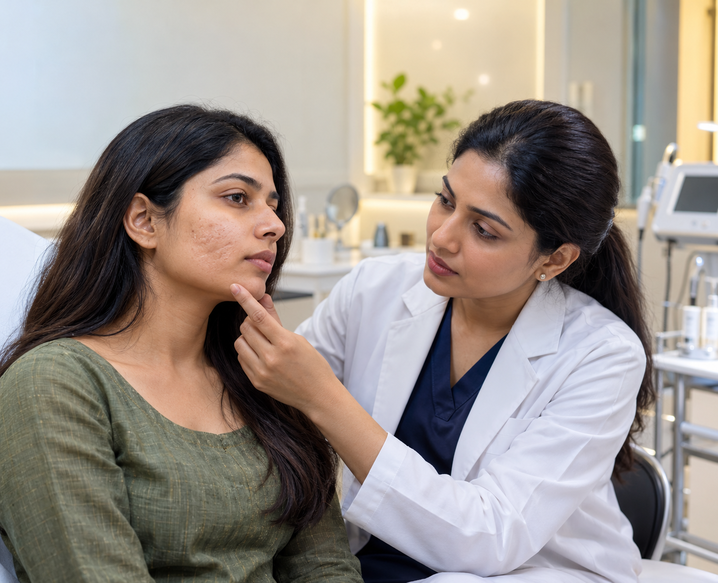
Subcision isn't advised if you have active acne, a bacterial or viral infection on the skin, a blood clotting disorder, or if you're on oral retinoids (isotretinoin). It also isn't used for keloid or hypertrophic scars.
To know if you're an ideal candidate for acne scar treatment in Delhi, consult the best skin specialist in Delhi/NCR at Dadu Medical Centre.

We can help with that! Schedule a free online consultation with one of our expert Doctors and we'll help you create a customized plan.
Book a free online consultation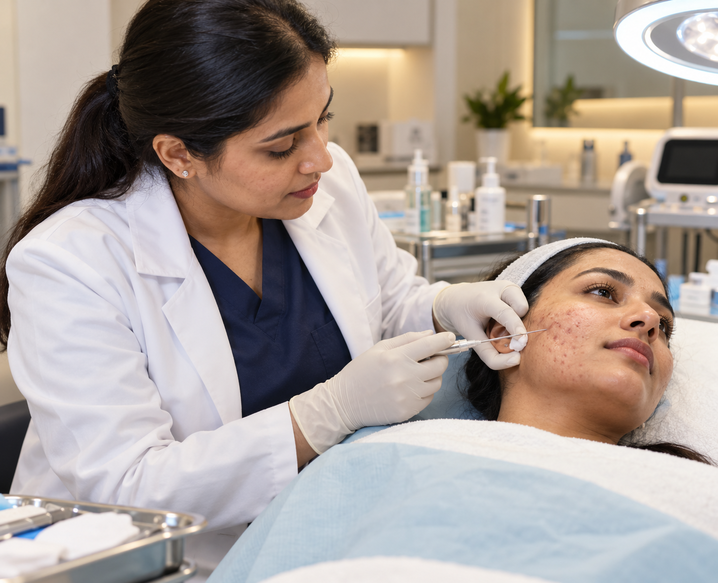
Before starting, the doctor cleans the area and gives local anaesthesia, so most people only feel a bit of pressure during the procedure. A thin needle is then put into the hypodermis, the layer just under the scar, and moved gently back and forth to break the fibrous bands holding the scar down. As the bands loosen, the scar lifts. A little bleeding happens under the skin, and as that area heals, new collagen forms and helps the scar stay raised.
Combination treatments: Subcision can be done by itself, though a lot of patients get better results when it's combined with microneedling, topical retinoids, TCA CROSS or fractional laser. Dr. Nivedita Dadu plans the combination and the number of sessions after looking at your scar type and depth.
Aftercare: Swelling and some bruising are normal for a few days and go away on their own. Keep the area clean, don't rub or press it unless your doctor tells you to, use sunscreen daily, and apply the creams or medicines prescribed.
It's a minor procedure, done without incisions, where a fine needle is passed under a depressed scar to cut the fibrous bands pulling it down. The scar lifts and new collagen forms in that area over the next few weeks.
Rolling scars respond the best, and boxcar scars also improve. It isn't used for keloid or hypertrophic scars, while ice-pick scars usually need TCA CROSS or another method.
If your scars don't flatten when you stretch the skin or smile, they're probably tethered. A dermatologist can confirm this by checking your skin at the consultation.
Local anaesthesia is given first, so it's mostly pressure you feel rather than pain. Expect swelling and bruising for a few days, which fade without much care.
Yes, and in many cases it should be. Microneedling, topical retinoids, TCA CROSS and fractional laser are common pairings, depending on your scars.
Anyone with active acne, a bacterial or viral skin infection, a blood clotting disorder, or who is taking oral retinoids. Your doctor will go through your history before planning it.
It depends on how many scars need treatment, the area, the number of sessions and whether other procedures are added. The final cost is confirmed at your consultation at Dadu Medical Centre.
Schedule your visit for this specialized treatment.